

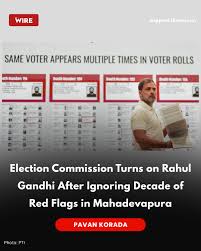
Rahul Gandhi’s Bold Accusations
In recent political developments in India, **Rahul Gandhi — the Leader of the Opposition in the Lok Sabha and a senior Congress leader — has lodged a series of high-profile accusations against the Election Commission of India (ECI). Gandhi’s statements go beyond routine political criticism, as he alleges that the ECI has abandoned its constitutional duty to protect democratic rights and instead become complicit in what he calls “vote chori” — literally “vote theft.” His claims touch on the integrity of electoral rolls, voter exclusion, and wider questions about the credibility of India’s electoral process.
These assertions have sparked fierce political debate, official pushback, and intense media coverage, making this one of the most talked-about controversies in Indian politics today.
What Rahul Gandhi Is Alleging
Understanding Rahul Gandhi’s Bold Accusations Against the ECI
At the heart of Gandhi’s critique is the Special Intensive Revision (SIR) of the electoral rolls carried out by the Election Commission. According to Gandhi, this process — originally meant to ensure accurate, up-to-date voter lists — has been misused to remove opposition supporters selectively. He argues that rather than a routine administrative task, the SIR has become a tool for manipulating electoral outcomes.
In his posts on social media and public statements, Gandhi wrote that where SIR has been implemented — particularly in states like Gujarat — there have been “significant instances” of voters being removed in a way that appears targeted. He cited cases where numerous objections were filed with the same name or where voters belonging to certain communities were disproportionately excluded from the rolls.
According to Gandhi:
-
The process was strategically directed to remove opposition-leaning voters.
-
Thousands of objections under the same names were filed, hinting at organized filing rather than legitimate citizen objections.
-
The Election Commission, in his view, did not act transparently or accountably in responding to these concerns.
Gandhi’s overarching charge is that the ECI has not merely erred but abandoned its constitutional role, “no longer a protector of democracy” but instead a participant in an alleged vote theft conspiracy — allegations that strike at the very heart of India’s democratic framework.
“Vote Chori”: More Than Just a Phrase
The term “vote chori” — Hindi for “vote theft” — has become synonymous with this political battle. Gandhi and other opposition figures argue it is not merely a catchy slogan but signifies a deeper problem of electoral manipulation and exclusion.
To support his argument, Gandhi has repeatedly emphasized the need for greater transparency in voter rolls, including the release of digitally accessible election data that citizens and political parties can independently audit. He has even launched online portals and calls for public participation to highlight alleged irregularities.
For Gandhi and supporters of his stance, “vote chori” symbolizes the erosion of trust in electoral administration and calls attention to what they see as systemic issues in how election data is controlled.
Political Context and Timing
Gandhi’s remarks come at a pivotal moment in Indian politics. With several state elections either recently held or on the horizon, tensions between the ruling Bharatiya Janata Party (BJP) and the opposition Indian National Congress have escalated. Under these circumstances, competition over electoral credibility has intensified, making the integrity of institutions like the Election Commission a point of major political contention.
Critics of Gandhi — including political opponents and commentators — argue that these accusations are politically motivated and timed to influence voter sentiment in key constituencies. Supporters of the BJP have labeled Gandhi’s allegations as exaggerated or unfounded, sparking sharp exchanges across public platforms and in media.
What the Election Commission Says
The Election Commission has responded firmly to Gandhi’s allegations. It has challenged him to produce evidence rather than use inflammatory language like “vote chori,” calling such phrasing a “dirty word” that undermines public confidence in the electoral process. The ECI is on record asserting that Indian election laws enshrine the principle of “one person, one vote” and that it remains committed to enforcing it.
Officials have indicated that if any claims of electoral fraud exist, they should be submitted with supporting documentation through proper legal channels, such as written affidavits, so that they can be investigated under law. The Commission has also highlighted that mechanisms are in place to dispose of claims and objections received during the roll revision process.
In effect, the ECI’s position is that allegations must be backed with official evidence and pursued through statutory procedures rather than public rhetoric — a stance that has fueled further debate.
Policy Demands From Gandhi
Beyond allegations, Rahul Gandhi has made specific demands aimed at strengthening electoral transparency, including:
-
Releasing digital voter lists in machine-readable formats so technical audits can be conducted.
-
Extending retention periods for CCTV and other election monitoring records to aid investigations.
-
Reforming how voter data and election evidence are shared and made accessible to political parties and civil society.
These demands reflect broader concerns about how electoral data is managed and whether current systems are adequate for fostering trust in India’s deeply complex election processes.
Public Reactions and Political Fallout
The accusations have provoked diverse reactions:
-
Judicial and academic observers warn that democratic institutions must maintain independence and that politicizing them can erode public trust.
-
Supporters of Gandhi see his stance as a necessary fight for electoral justice, especially for marginalized communities allegedly affected by voter list revisions.
-
The ruling party and its advocates argue that elections are transparent and that such allegations are politically charged attempts to delegitimize electoral outcomes.
This debate illustrates a larger struggle over how democracy functions in India — with competing narratives about integrity, transparency, and accountability at its core.