

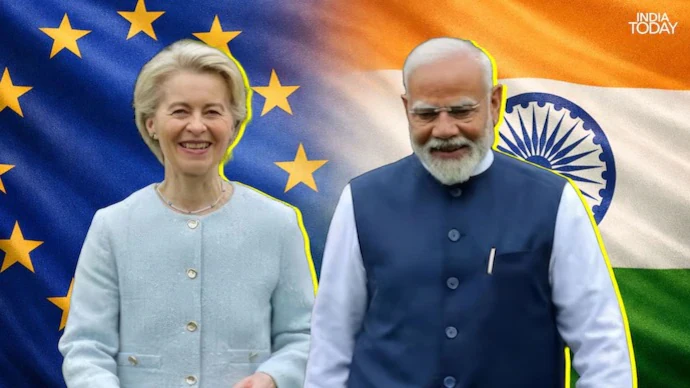
India–EU trade deal
The India–EU trade deal marks one of the most significant economic developments in recent decades. After nearly 20 years of negotiations, India and the European Union (EU) have concluded discussions on a sweeping Free Trade Agreement (FTA) that is being hailed as the “mother of all trade deals.” Designed to dramatically boost commerce, reduce tariffs, and deepen strategic ties, this pact represents a major shift in how two of the world’s largest economic blocs will conduct business in the 21st century.
Set against the backdrop of a rapidly changing global economy, rising protectionism in some markets, and shifting strategic alliances, the India–EU trade deal is not just about lowering duties — it’s about redefining economic integration across continents.
Origins and Long Road to Agreement
The journey toward an India–EU FTA began as far back as 2007, when initial talks were launched with optimism. However, progress stalled in the early 2010s due to disagreements over market access, tariffs, and regulatory standards. After a long hiatus, discussions resumed with renewed energy in 2022, driven by geopolitical pressures, global supply chain realignments, and mutual desire for diversification of trade markets.
The pact’s finalization in early 2026 coincided with India’s 77th Republic Day celebrations, during which the European Commission President and European Council President were invited as chief guests — underlining the diplomatic importance of the deal.
What the Deal Covers: Key Provisions and Features
At its core, the India–EU trade deal is designed to:
Reduce or Eliminate Tariffs
The agreement is expected to gradually eliminate or significantly reduce tariffs on over 90% of traded goods. For example, India is planning to cut import duties on certain European cars from as high as 110% to 40% initially, and later down to 10%, making European vehicles more competitive in the Indian market.
Similarly, European exporters stand to gain easier access for machinery, chemicals, wine, spirits, and other manufactured products — boosting trade flows both ways.
Liberalization of Services
Beyond goods, the pact is expected to open up opportunities in services sectors like telecommunications, transport, accounting, and professional services. Easing regulatory barriers in services can generate new export avenues for Indian firms and open up the EU market more broadly.
Strategic Economic Integration
The agreement is more than a tariff reduction mechanism — it reflects strategic alignment between India and the EU, enabling them to diversify global trade routes and reduce dependence on traditional markets like the United States and China. Analysts see this as particularly relevant amid rising tariffs and economic nationalism elsewhere.
Economic Significance and Scale
Before the deal, India’s bilateral trade in goods with the EU was already massive — approximately $136.53 billion in 2024–25, making the EU India’s largest goods trading partner. India exported roughly $75.85 billion worth of goods and imported $60.68 billion in the same period.
Economists project that by 2031, this trade volume could grow by another $50 billion, further cementing the EU’s role as a major market for Indian products.
The deal’s scale is immense — covering two billion people and approximately 25% of global GDP. This makes it one of the largest free trade areas in the world by economic footprint.
Sectoral Winners: Who Benefits Most?
The impact of the India–EU trade deal spans multiple industries:
Manufacturing and Exports
Indian manufacturers of textiles, leather goods, chemicals, and electronic components are poised to benefit from reduced barriers in the EU. These are sectors where India already has competitive strength and can gain further market share.
European manufacturers, especially in automotive and machinery segments, will see improved access to the enormous Indian market. This is expected to spur investment by European firms in India.
Pharmaceuticals and Healthcare
India’s pharmaceutical industry, which has a strong global presence, could see expanded access to European markets. Reduced tariffs and harmonized regulations can help Indian drugs reach consumers more competitively.
Services and Technology
The liberalization of services could boost India’s IT and consulting sectors. Easier movement of professionals and cross-border digital services may enhance business opportunities.
Challenges and Controversies
Despite the positive outlook, the India–EU trade deal faces several challenges:
Agriculture Exclusion
Some sectors, like agriculture, remain politically sensitive. Agricultural products and major staples are being excluded from full liberalization due to domestic concerns about protecting farmers and food security.
Environmental and Regulatory Standards
The EU’s strict environmental standards, especially the Carbon Border Adjustment Mechanism (CBAM), pose challenges for carbon-intensive Indian industries such as steel and aluminum. Indian negotiators have pushed back on certain requirements, arguing for flexibility and fairness.
Geopolitical Pushback
Not all global players are supportive. U.S. officials have voiced criticism, claiming that the deal could weaken U.S. leverage and influence in global trade — particularly regarding energy and tariffs. These reactions signal broader geopolitical tensions surrounding global trade realignment.
What It Means for India’s Future
The India–EU trade deal carries economic and geopolitical importance for India’s long-term strategy:
- Diversified Export Markets — Reduces dependence on single markets.
- Increased Foreign Investment — More predictable access for European businesses boosts confidence.
- Strategic Global Positioning — Strengthens India’s role in shaping global trade norms.
In an era where supply chains are being rethought, and countries seek resilient, diversified partnerships, the India–EU deal positions India as a key player in multilateral economic frameworks.
A Historic Milestone
The India–EU trade deal is more than a commercial agreement — it is a strategic milestone that reflects deepening economic cooperation between two global powerhouses. Once fully ratified and implemented, it will enhance trade flows, unlock opportunities for industries on both sides, and contribute to broader geopolitical stability in an uncertain global economic environment.