

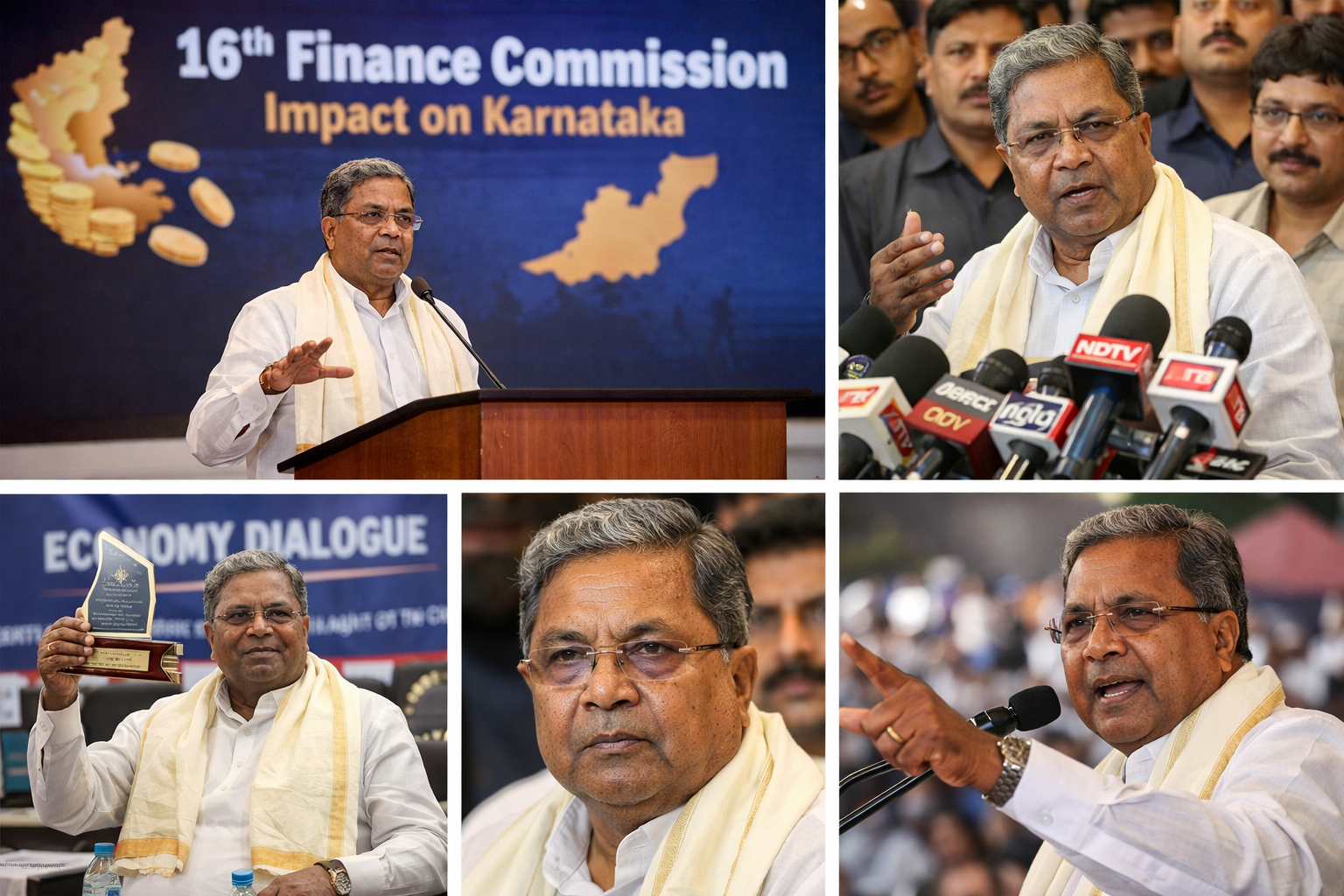
Karnataka revenue loss due to 16th Finance Commission has emerged as a major political and economic concern after Chief Minister Siddaramaiah warned that the state could lose anywhere between ₹10,000 crore and ₹15,000 crore if the recommendations of the 16th Finance Commission are implemented in their current form. The statement has triggered a fresh debate on fiscal federalism, Centre–State relations, and whether southern states like Karnataka are being unfairly penalized for better economic and population performance.
What Is the 16th Finance Commission?
The Finance Commission is a constitutional body formed under Article 280 of the Indian Constitution. Its primary role is to recommend how tax revenues collected by the Centre should be distributed between the Union and the states.
The 16th Finance Commission (16th FC) will determine revenue-sharing formulas for the period starting from 2026. Its recommendations will directly impact how much money states receive from the Centre for governance, welfare schemes, infrastructure development, and public services.
While Finance Commissions aim to promote balanced development across states, their formulas often become controversial—especially for economically stronger states.
Siddaramaiah’s Strong Warning
Chief Minister Siddaramaiah has publicly expressed serious concern over the potential financial impact on Karnataka. According to him, Karnataka revenue loss due to 16th Finance Commission could severely hurt the state’s development capacity.
He argued that Karnataka, which contributes significantly to India’s tax pool, stands to lose a massive amount despite being one of the most economically productive states in the country.
“Karnataka contributes more to the Centre than what it gets back. The new Finance Commission recommendations will further widen this imbalance,” Siddaramaiah said.
Why Karnataka Could Lose ₹10,000–₹15,000 Crore
The projected loss is mainly due to changes in criteria used for tax devolution, including:
1. Population Weightage
Newer Finance Commissions give higher weightage to population data from the 2011 Census rather than the 1971 Census. Southern states like Karnataka, which successfully controlled population growth, end up losing funds compared to states with higher population growth.
2. Income Distance Formula
States with lower per capita income receive more funds to bridge economic gaps. While this supports poorer states, it reduces the share for states like Karnataka that have higher per capita income due to better governance and industrial growth.
3. Performance Penalty
Ironically, states that performed well in health, education, family planning, and tax collection face reduced allocations, while underperforming states gain more.
Siddaramaiah has called this approach “punishing progress and rewarding inefficiency.”
Karnataka’s Contribution vs Return
Karnataka is among India’s top contributors to central taxes. Bengaluru alone generates massive revenue through IT exports, startups, GST, and income tax.
However, according to state government data:
- Karnataka sends significantly more money to the Centre
- The amount returned through central allocations is comparatively lower
- The gap is expected to widen after the 16th FC recommendations
This imbalance strengthens the argument around Karnataka revenue loss due to 16th Finance Commission.
Impact on Development and Welfare Schemes
A revenue loss of ₹10,000–₹15,000 crore is not just a number—it has real consequences for people.
Possible Effects:
- Reduced funding for welfare schemes like free electricity, food security, and social pensions
- Slower infrastructure development (roads, metro expansion, irrigation projects)
- Less investment in education and healthcare
- Financial stress on state-run programs
The Karnataka government fears it may have to either cut spending or increase borrowing if central allocations drop.
Political Reactions and Federalism Debate
Siddaramaiah’s statement has reignited the broader debate on Indian federalism.
Opposition View
Opposition parties argue that Finance Commission formulas are necessary to support backward states and ensure national balance.
State Government’s Stand
Karnataka’s ruling government insists that:
- Fiscal responsibility should not be punished
- Economic contribution must be respected
- Federal structure should ensure fairness, not uniformity
Several southern states, including Tamil Nadu and Kerala, have raised similar concerns in the past.
Is This a North vs South Issue?
Though not openly stated, many analysts believe this issue reflects a growing North–South divide in fiscal policy.
Southern states:
- Lower population growth
- Higher literacy and health indicators
- Better tax compliance
Northern states:
- Higher population growth
- Lower per capita income
- Receive higher central assistance
The 16th Finance Commission’s approach may deepen this divide unless corrective measures are introduced.
What Karnataka Is Demanding
The Karnataka government is expected to:
- Submit formal objections to the Finance Commission
- Demand a fairer revenue-sharing formula
- Push for greater weightage to economic contribution and tax effort
- Seek protection for high-performing states
Siddaramaiah has also hinted at building consensus with other affected states to present a united front.
Expert Opinions
Economic experts suggest that while redistribution is important, the system must:
- Incentivize good governance
- Avoid discouraging performance
- Maintain trust between Centre and states
Some economists have proposed a dual formula, balancing equity and efficiency.
What Happens Next?
The 16th Finance Commission is still in the consultation phase. Final recommendations will be submitted to the President of India after discussions with:
- State governments
- Economists
- Policy experts
- Central ministries
This means there is still room for negotiation and revision.
Why This Matters to Common Citizens
Even if you’re not into politics, Karnataka revenue loss due to 16th Finance Commission affects:
Quality of public services
Speed of development projects
Job creation
Cost of living and state taxes
Less money for the state ultimately impacts everyday life
The warning issued by Chief Minister Siddaramaiah has brought national attention to a critical issue. If Karnataka indeed loses ₹10,000–₹15,000 crore due to the 16th Finance Commission, it could reshape the state’s financial planning and development priorities.
At its core, this debate is about fairness—how India balances support for weaker states while respecting the contribution of stronger ones. As discussions continue, all eyes will be on whether the Finance Commission addresses these concerns or sticks to its current framework.
One thing is clear: the outcome will play a crucial role in shaping Karnataka’s future and the broader structure of India’s federal economy.