

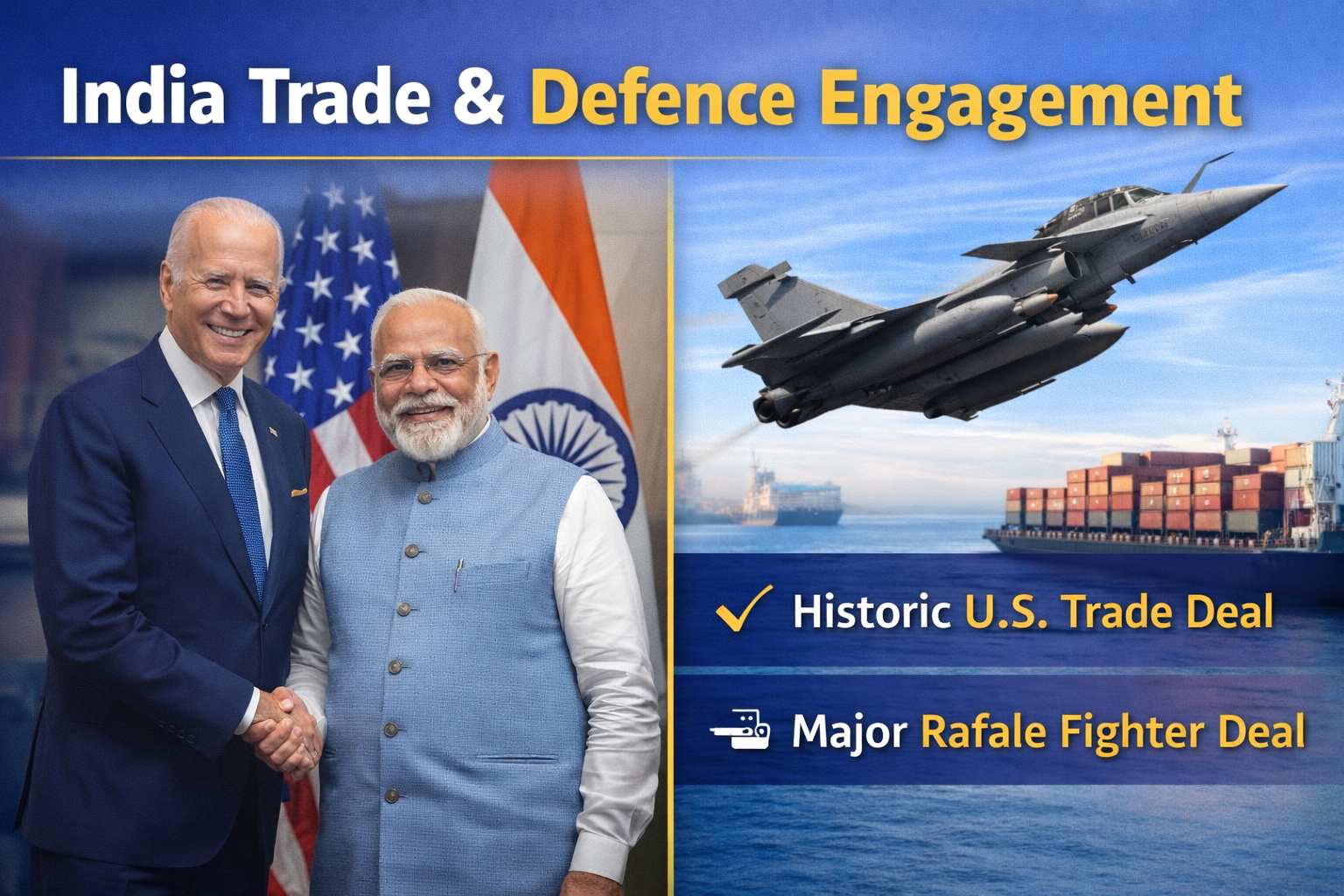
India Trade and Defence Engagement: Historic U.S. Trade Deal and Major Rafale Acquisition Highlight Strategic Growth
India trade and defence engagement is emerging as a defining story of India’s trajectory on the global stage in early 2026. Two major developments — a historic interim trade framework with the United States and India’s approval of a massive defence procurement plan for 114 French Rafale fighter jets — underscore a shift in India’s diplomatic, economic, and security priorities that reflect its expanding geopolitical influence and economic integration with global partners.
In this article, we explore the background and significance of these developments, what they mean for India’s economy and defence architecture, and how they contribute to India’s role as a key global power.
Historic Interim Trade Framework Between India and the United States
One of the biggest news items in India’s international economic engagement in 2026 is the release of an interim trade framework between India and the United States, which represents substantial progress toward a broader bilateral trade deal that could reshape economic ties between the two largest democracies.
Key Features of the Interim Trade Framework
The interim agreement, announced on February 6, 2026, includes several key components:
-
Reduction of U.S. tariffs on most Indian exports to around 18% — a substantial drop from the previous average levels.
-
In return, India agreed to halt direct and indirect purchases of Russian oil, which previously triggered punitive tariffs on Indian imports.
-
Both sides committed to cooperate on regulatory alignment, export controls, and safety certifications to support smoother bilateral trade.
India’s Trade Minister also made clear that around 90–95% of Indian agricultural products were kept out of immediate tariff concessions, protecting sensitive farming sectors while allowing textile and apparel exporters to benefit from zero-tariff access under certain conditions.
Strategic Trade Implications
This trade framework — while still “interim” — represents a milestone in India’s economic diplomacy:
-
Deepening economic integration with a top global market like the U.S.
-
Balancing trade interests with domestic priorities like protecting farmers and textile producers
-
Positioning India as a more reliable partner in global supply chains
-
Reducing punitive tariffs that previously held back Indian exports
However, there are economic concerns too. Some analysts have cautioned that an ambitious target of importing up to $500 billion in U.S. goods over five years, part of the framework, could widen India’s trade deficit unless carefully managed.
Large Defence Procurement: 114 Rafale Fighter Jets
On the defence front, India has taken a major step toward modernizing its military strength by approving a huge procurement of 114 Rafale fighter jets from France, valued at approximately ₹3.25 lakh crore (~$280 billion).
Details of the Rafale Procurement Plan
According to defence sources:
-
The Defence Acquisition Council (DAC), chaired by Defence Minister Rajnath Singh, granted Acceptance of Necessity (AoN) for acquiring 114 Rafale multi-role fighter jets for the Indian Air Force.
-
Of these, about 18 aircraft will be procured off-the-shelf, while the remaining 96 will be manufactured in India, contributing to domestic defence production under the Government’s Make in India initiative.
-
The deal also includes technology transfer and strategic partnership components aimed at expanding India’s aerospace capabilities.
The procurement is seen as one of India’s largest defence acquisitions in history and comes at a time when the Indian Air Force is striving to address critical fighter squadron shortfalls.
Strategic Defence Significance
The Rafale jets are multi-role aircraft capable of air superiority, precision strike, and electronic warfare missions, making them vital for India’s long-term deterrence posture. The deal is expected to:
-
Improve combat competitiveness with near-peer adversaries
-
Accelerate modernisation of India’s air defence fleet
-
Strengthen indigenous production capacity through shared technology efforts
-
Generate skilled defence manufacturing jobs domestically
Furthermore, the clearance of this deal ahead of French President Emmanuel Macron’s official visit to New Delhi confirms that defence collaboration with France remains a cornerstone of India’s strategic partnerships.
How Trade and Defence Engagement Fit India’s Global Strategy
The simultaneous developments in trade and defence are not isolated events — they form part of a broader geopolitical and economic strategy that reflects India’s ambitions to be a major global player.
1. Balancing Economic and Strategic Interests
India’s deepening trade ties with the United States show a willingness to integrate into large global markets while safeguarding sensitive sectors. At the same time, investments in defence procurement highlight a focus on national security and regional stability.
2. Enhancing Global Partnerships
The U.S. trade framework and the Rafale deal with France illustrate India’s multi-vector foreign policy, engaging with partners across continents — the U.S., Europe, and beyond — to build resilient economic and strategic linkages.
3. Supporting Domestic Growth
Both initiatives have domestic implications:
-
Trade liberalisation has the potential to boost exports, foreign investment, and job creation
-
Defence manufacturing agreements underlicence and collaboration can boost industrial growth and technology transfer inside India
Challenges and Considerations
While there is optimism around India’s growing trade and defence engagement, there are also key considerations:
-
Economic Balance
The ambitious trade import targets and tariff changes could potentially widen trade deficits if not matched by export growth.
-
Domestic Sector Sensitivity
Agricultural and small industries need protection even as markets open up — a balance India appears to be negotiating in the framework deal.
-
Defence Self-Reliance vs. Foreign Dependence
Large imports of foreign-made jets sustain security needs but also raise questions about long-term self-reliance in defence technology — a challenge frequently discussed by policymakers.
The twin developments of a historic interim trade framework with the United States and the approval of a major Rafale fighter acquisition demonstrate that India trade and defence engagement is evolving rapidly. These moves signal India’s readiness to anchor itself more firmly on the world stage — economically, militarily, and diplomatically.
As India continues to forge strategic partnerships, expand its industrial base, and strengthen its defence capabilities, the country’s global influence and role as a pivotal power in both regional and global affairs is increasingly clear.
These developments not only reflect India’s internal policy priorities but also its broader contribution to shaping a stable and connected international order in the decades ahead.