

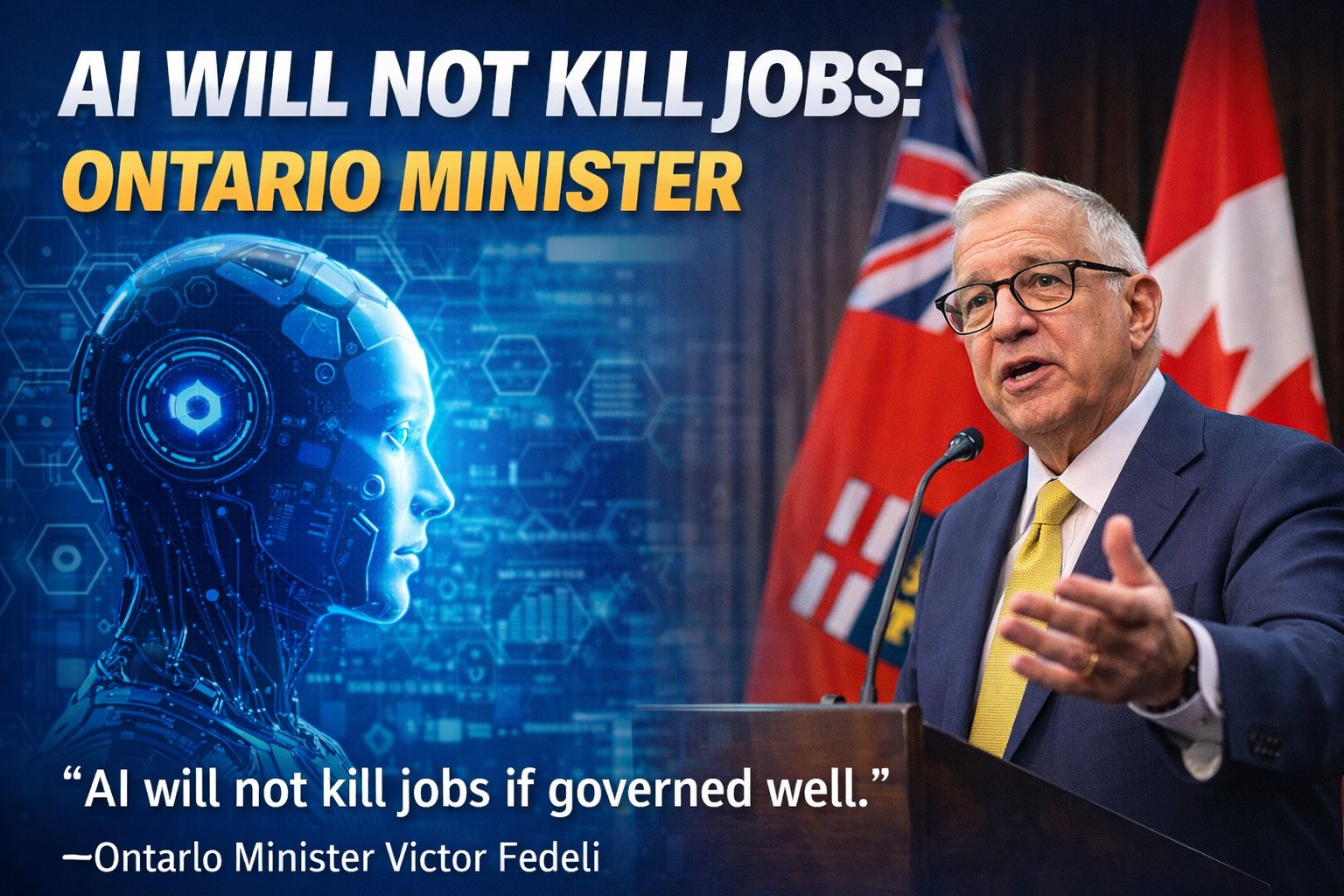
AI Will Not Kill Jobs If Governed Well, Says Ontario Minister Victor Fedeli
AI will not kill jobs—this is the clear message delivered by Victor Fedeli, a senior minister from Ontario, as global anxiety grows over artificial intelligence replacing human workers. Speaking on the future of technology and employment, Fedeli emphasized that strong governance, ethical frameworks, and investment in skills can ensure AI becomes a job creator rather than a job destroyer.
As artificial intelligence rapidly enters workplaces—from software development and healthcare to manufacturing and finance—concerns about mass unemployment have intensified worldwide. However, Fedeli’s remarks offer a more balanced and hopeful perspective, positioning AI as a transformative tool that can strengthen economies when handled responsibly.
The Global Fear: Will AI Replace Human Jobs?
The fear surrounding AI and job losses is not new. Automation has historically displaced certain roles, from factory workers during the industrial revolution to clerical jobs in the digital age. AI, however, feels different because of its ability to think, analyze, and learn, tasks once believed to be uniquely human.
Many workers worry that AI tools such as generative models, autonomous systems, and intelligent software will make human labor obsolete. Headlines predicting “AI takeover” and “job extinction” have further amplified public anxiety.
Victor Fedeli directly addressed these fears by stating that technology itself is not the enemy—poor governance is.
Victor Fedeli’s Core Message: Governance Is the Key
According to Fedeli, AI’s impact on employment depends entirely on how governments, companies, and institutions choose to regulate and deploy it. He highlighted three critical pillars:
-
Responsible AI governance
-
Continuous workforce reskilling
-
Public–private collaboration
Fedeli stressed that AI should augment human capabilities, not replace them outright. When used thoughtfully, AI can remove repetitive tasks, improve efficiency, and allow workers to focus on creativity, strategy, and decision-making.
AI as a Job Creator, Not a Job Killer
Contrary to popular belief, AI is already creating new job categories. Roles such as AI ethics officers, data scientists, prompt engineers, machine learning specialists, and AI product managers barely existed a decade ago.
Fedeli pointed out that every major technological shift in history has created more jobs than it destroyed, although the nature of work changed. AI, he argues, will follow the same pattern—provided governments invest in education and skill development.
Examples of AI-Driven Job Growth:
-
AI system trainers and auditors
-
Cybersecurity specialists
-
Health-tech professionals
-
Smart manufacturing engineers
-
AI policy and compliance experts
Reskilling: The Backbone of AI-Friendly Employment
One of Fedeli’s strongest arguments focused on reskilling and upskilling the workforce. Rather than resisting AI, workers must be equipped to work alongside it.
Ontario, for example, is investing heavily in:
-
STEM education
-
Technical training programs
-
Industry–academia partnerships
-
Digital literacy initiatives
Fedeli emphasized that lifelong learning is no longer optional. Governments must ensure workers can transition smoothly from declining roles to emerging opportunities.
AI Governance: Why Rules Matter
Fedeli warned that unregulated AI adoption could widen inequality and concentrate power in the hands of a few corporations. That’s why clear AI policies are essential.
Good governance includes:
-
Ethical AI standards
-
Transparency in algorithms
-
Bias and discrimination checks
-
Accountability mechanisms
-
Worker protection laws
With these safeguards, AI can become a force for inclusive growth, not disruption.
A Model for the World, Not Just Ontario
While Fedeli spoke from an Ontario perspective, his message resonates globally—especially in countries like India, where AI adoption is accelerating across IT services, startups, and government platforms.
Developing economies stand to gain significantly from AI, but only if they:
-
Protect workers during transitions
-
Invest in digital skills early
-
Encourage innovation without exploitation
Fedeli’s approach provides a template for balanced AI adoption worldwide.
Role of Companies in Protecting Jobs
Fedeli also placed responsibility on private companies. Businesses adopting AI must:
-
Retrain existing employees instead of replacing them
-
Use AI to boost productivity, not cut costs blindly
-
Maintain transparency with workers about AI use
He argued that ethical business practices will determine whether AI enhances or harms employment.
Public–Private Collaboration Is Essential
Governments alone cannot manage AI’s impact. Fedeli called for strong collaboration between policymakers, industry leaders, and educational institutions.
Such partnerships can:
-
Align education with industry needs
-
Create AI-ready talent pipelines
-
Encourage responsible innovation
-
Prevent skill mismatches in the labor market
The Future of Work in an AI-Driven World
Fedeli remains optimistic about the future. He believes AI will:
-
Improve job quality
-
Increase productivity
-
Enable flexible work models
-
Drive economic growth
However, this future is not automatic. It requires intentional policy choices made today.
AI Will Not Kill Jobs—Neglect Will
Victor Fedeli’s message is clear and timely: AI will not kill jobs if governed well. Fear-driven narratives overlook the real challenge—not AI itself, but the absence of thoughtful planning.
With the right mix of governance, education, ethical standards, and collaboration, AI can usher in a new era of opportunity rather than unemployment.
As nations race to adopt artificial intelligence, Fedeli’s words serve as a reminder that technology should work for people—not the other way around.