

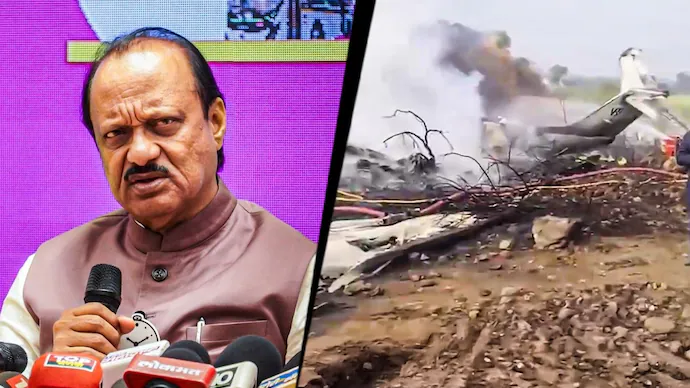
Ajit Pawar emergency landing plane crash is the headline that has dominated Indian news on January 28, 2026, after a chartered aircraft carrying Maharashtra’s Deputy Chief Minister crashed during its landing approach near Baramati Airport in Pune district. The tragic accident not only shook the state politically but also raised urgent questions about aviation safety procedures at smaller regional airports in India.
Incident Overview
On Wednesday morning, a Bombardier Learjet 45 business jet, registered VT-SSK and operated by VSR Aviation, was flying from Chhatrapati Shivaji Maharaj International Airport in Mumbai to Baramati Airport. The aircraft was carrying Deputy Chief Minister Ajit Pawar, two of his aides, and two crew members when it encountered trouble during the landing phase.
The plane attempted to land around 8:45 AM IST, but for reasons still under investigation, it veered off the runway and crash-landed at the airport’s threshold, erupting in flames moments later. Eyewitnesses reported a massive fireball and thick black smoke rising from the wreckage.
Step-by-Step Timeline
Before Departure:
The Learjet 45 took off from Mumbai earlier that morning, carrying Ajit Pawar and team to attend several political meetings and public engagements in the Baramati region.
Approach to Baramati:
Flight data and eyewitnesses indicate the aircraft made an initial approach but was unable to land successfully — possibly due to alignment issues or visibility challenges. It then circled the airport, preparing for a second approach.
Crash Sequence:
During the second landing attempt, the jet lost control shortly before reaching the runway. It crash-landed amidst a series of explosions and a fireball that engulfed the fuselage. Rescue teams arrived quickly, but the intensity of flames made access extremely difficult.
People on Board
According to confirmed reports:
-
Ajit Pawar, Deputy Chief Minister of Maharashtra
-
Two security aides (including his Personal Security Officer and attendant)
-
Two crew members (pilot-in-command and first officer)
were on board when the crash occurred.
Eyewitness Accounts
Villagers and local residents near Baramati Airport shared harrowing descriptions: as the aircraft descended, it appeared unstable, and moments later it hit the ground with tremendous force. Explosions followed, making rescue efforts all the more challenging. One eyewitness recalled seeing several consecutive blasts shortly after impact, which prevented people from approaching the aircraft.
CCTV footage later shared by media outlets showed the aircraft’s downward trajectory, impact with the ground and subsequent bursts of fire, underscoring the suddenness and severity of the situation.
Early Investigation and Causes Under Review
The Directorate General of Civil Aviation (DGCA) has taken charge of the preliminary investigation. Initial assessments suggest the aircraft may have struggled during its landing phase, possibly due to technical issues, pilot decision-making under challenging conditions, or environmental factors like visibility.
Experts stress that small regional airports like Baramati may not have advanced landing systems such as ILS (Instrument Landing System), which means pilots often rely more heavily on visual cues, particularly in the early morning hours when visibility can vary.
Both cockpit voice recorder and flight data recorder will be examined to reconstruct the final moments of the flight and pinpoint the precise sequence leading to the crash.
About the Aircraft
The aircraft involved was a Bombardier Learjet 45 XR, a mid-size business jet designed for short-to-medium regional flights. The specific aircraft, VT-SSK, was about 16 years old. Investigators will review its maintenance history, performance logs, and any potential mechanical vulnerabilities.
National and State Leadership Reactions
News of the Ajit Pawar emergency landing plane crash sent shockwaves through political circles:
-
Prime Minister Narendra Modi expressed deep condolences, acknowledging Pawar’s long public service and dedication.
-
Senior national and state politicians, including chief ministers and party leaders, visited the crash site or communicated with local authorities to oversee rescue operations and support families of victims.
Public reaction has similarly swung between grief and concern, with condolences pouring in from across India and social media filled with tributes to Pawar’s legacy.
Impact on Maharashtra Politics
Ajit Pawar has been a significant figure in Maharashtra politics for decades, known for his leadership in regional development initiatives and governance. This crash has abruptly disrupted planned political engagements, especially with upcoming elections in several local bodies.
While the full political implications will unfold over the coming days and weeks, this incident represents a major moment in the state’s current affairs — one marked by both loss and uncertainty.
Safety and Aviation Perspectives
Aviation analysts are already highlighting that emergency landings — and the crashes that sometimes follow — underscore the complexities and risks inherent in regional operations. While emergency landings are often precautionary and successful, this tragic event demonstrates how rapidly situations can escalate.
DGCA and AAIB (Aircraft Accident Investigation Bureau) involvement ensures a comprehensive probe that could lead to recommendations for improved safety protocols, better landing aids at smaller airports, and possibly changes in charter flight regulations.
The Ajit Pawar emergency landing plane crash near Baramati is one of the most defining aviation tragedies in recent Indian history. With all five people onboard killed and investigations underway, the focus now shifts toward understanding what went wrong, honoring those lost, and learning lessons that may prevent future accidents.
As details continue to emerge from official sources, keep this page updated with verified developments — and avoid repeating unconfirmed rumors that can mislead readers and misinform platforms like Google Discover.