

India Social Media Takedown Rule: New 3-Hour Deadline, AI Content Labelling & Impact Explained
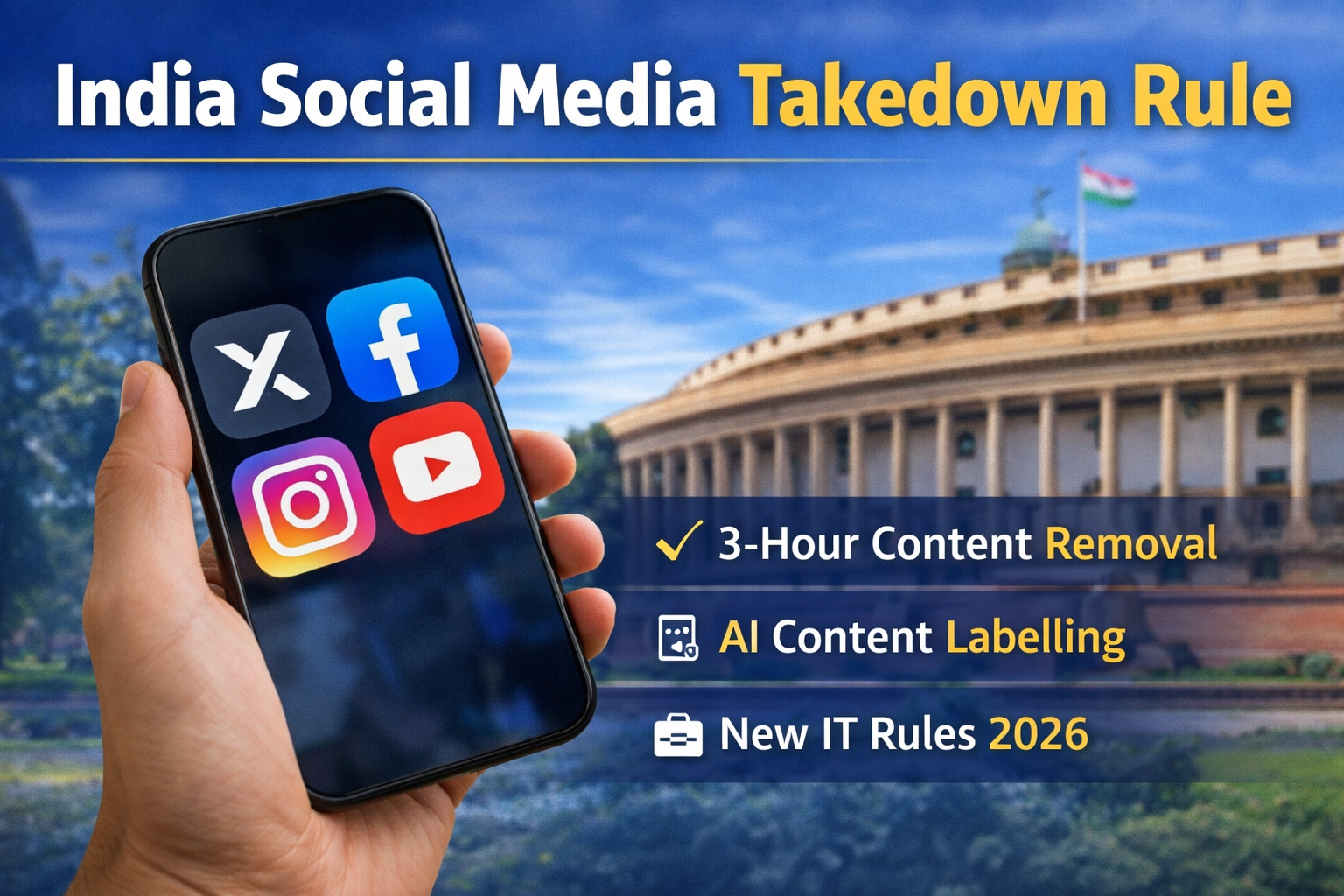
India social media takedown rule has been dramatically tightened with a new mandate requiring social media platforms to remove unlawful, harmful, or flagged content within just three hours of notification — a sharp reduction from the previous 36-hour window under the 2021 Information Technology (IT) rules. This change forms part of the amended IT intermediary guidelines set to come into force from February 20, 2026, aimed at curbing the rapid spread of harmful digital content and enhancing digital accountability in the age of generative AI.
In this article, we break down what the India social media takedown rule entails, why the government changed it, how it impacts users and tech giants, concerns raised by critics, and what this means for the future of digital regulation in India.
What Is the India Social Media Takedown Rule?
The India social media takedown rule refers to amended provisions under the Information Technology (Intermediary Guidelines and Digital Media Ethics Code) Rules, 2021. Under the latest update the government has:
-
Reduced the deadline for removing “unlawful or harmful content” on social media platforms to three hours.
-
Introduced mandatory labelling and traceability requirements for AI-generated or synthetic content.
-
Significantly expanded compliance requirements for platforms like Meta (Facebook & Instagram), Google (YouTube), X (formerly Twitter), and others.
These changes aim to address the fast spread of misleading or dangerous information and improve user protection online.
Effective Date and Legal Context
The amended rules were notified by the Ministry of Electronics and Information Technology (MeitY) and will come into effect from February 20, 2026.
These changes revise the earlier framework introduced under the IT Rules, 2021, which already governed intermediary liability, content removal processes, and grievance redressal mechanisms for online platforms.
Why the Change Was Introduced
The government has cited multiple reasons for tightening the India social media takedown rule:
Growing Influence of AI and Deepfakes
With the rapid advancement of artificial intelligence and the proliferation of AI-generated content — often indistinguishable from real media — regulators want to curb misleading or harmful synthetic media before it spreads widely online.
Faster Response to Harmful Content
The shift from 36 hours to three hours is aimed at helping platforms act faster on content flagged by government authorities or users, thus reducing the circulation of violence-inciting, defamatory, or unlawful material.
Increased Accountability
The amended rules also place greater responsibility on social media platforms to use automated tools and to clearly label AI-generated content so users can distinguish it from genuine content.
What Content Falls Under These Rules?
Under the amended guidelines:
“Unlawful or Harmful Content” includes:
-
Material that violates Indian criminal laws
-
Content inciting violence, hate, or public disorder
-
Defamatory or sexually exploitative material
-
Impersonation and fake news
-
Extreme or terrorist content
-
AI-generated deepfake media without proper disclosure
AI-Generated or Synthetic Media Requirements
Platforms must:
-
Label synthetic content clearly and prominently
-
Embed metadata or unique identifiers where technically feasible
-
Treat AI content equitably with other unlawful information if it violates laws
What the 3-Hour Takedown Rule Means
The key feature of the updated India social media takedown rule is the three-hour response window:
When a platform is notified of unlawful or legally questionable content, it must:
-
Remove the content within 3 hours, or
-
Disable access to it
This deadline is drastically shorter than the previous 36-hour timeline under the 2021 rules and reflects a desire to act quickly against harmful or misleading posts.
Impact on Tech Platforms
Compliance Challenges
Reducing the timeline to three hours poses operational challenges for platforms that often rely on human review teams to assess context and legality. Critics argue this could lead to:
-
Automated moderation mistakes
-
Over-removal of content
-
Increased censorship due to risk aversion
AI Labelling and Verification
Platforms are now required to detect and label AI-generated content, imposing new technical burdens involving metadata, traceability, and user-declaration tools.
Possible Penalties
Failure to comply with the takedown deadlines could lead to platforms losing legal protections under Section 79 of the IT Act, exposing them to liabilities and penalties.
Responses from Industry and Digital Rights Groups
Concerns Over Censorship
Digital rights organizations and some tech commentators say the India social media takedown rule might push platforms toward automated over-removal, effectively stifling legitimate expression and debate.
Practicality Questions
Experts argue that three hours might be an unrealistic window for meaningful human review, especially for complex cases involving context-dependent speech.
Support for Combating Deepfakes
Some analysts appreciate the regulatory focus on addressing AI-generated content, viewing labelling and traceability as positive steps toward reducing misinformation risks.
What It Means for Users in India
For everyday users and creators:
-
Platforms may remove flagged content quickly — sometimes without extended deliberation
-
AI-generated posts will increasingly carry labels
-
Users may see faster action on potentially harmful content
However, there is a risk that legitimate posts could be incorrectly removed if platforms rely too heavily on automated moderation.
Summary: Key Changes Under the New Rule
| Aspect | Old Rule | New Rule (2026) |
|---|---|---|
| Takedown Deadline | 36 hours | 3 hours |
| AI Content Regulation | No clear labelling rule | Mandatory AI labelling & traceability |
| Compliance Window | Longer review time | Rapid removal required |
| Unlawful Content Scope | Traditional content | Includes synthetic & AI-generated |
| Enforcement Risk | Lower | Higher due to strict timelines |
The updated India social media takedown rule marks one of the most significant shifts in digital regulation policy in recent years. By reducing the takedown timeline to just three hours and enhancing AI content rules, the Indian government aims to curb misinformation, hate speech, and harmful content swiftly. However, this comes with substantial challenges for platforms and raises important questions about freedom of expression, transparency, and technical feasibility.
As these rules roll out from February 20, 2026, they will likely shape how digital platforms operate in India and influence online discourse for years to come.