

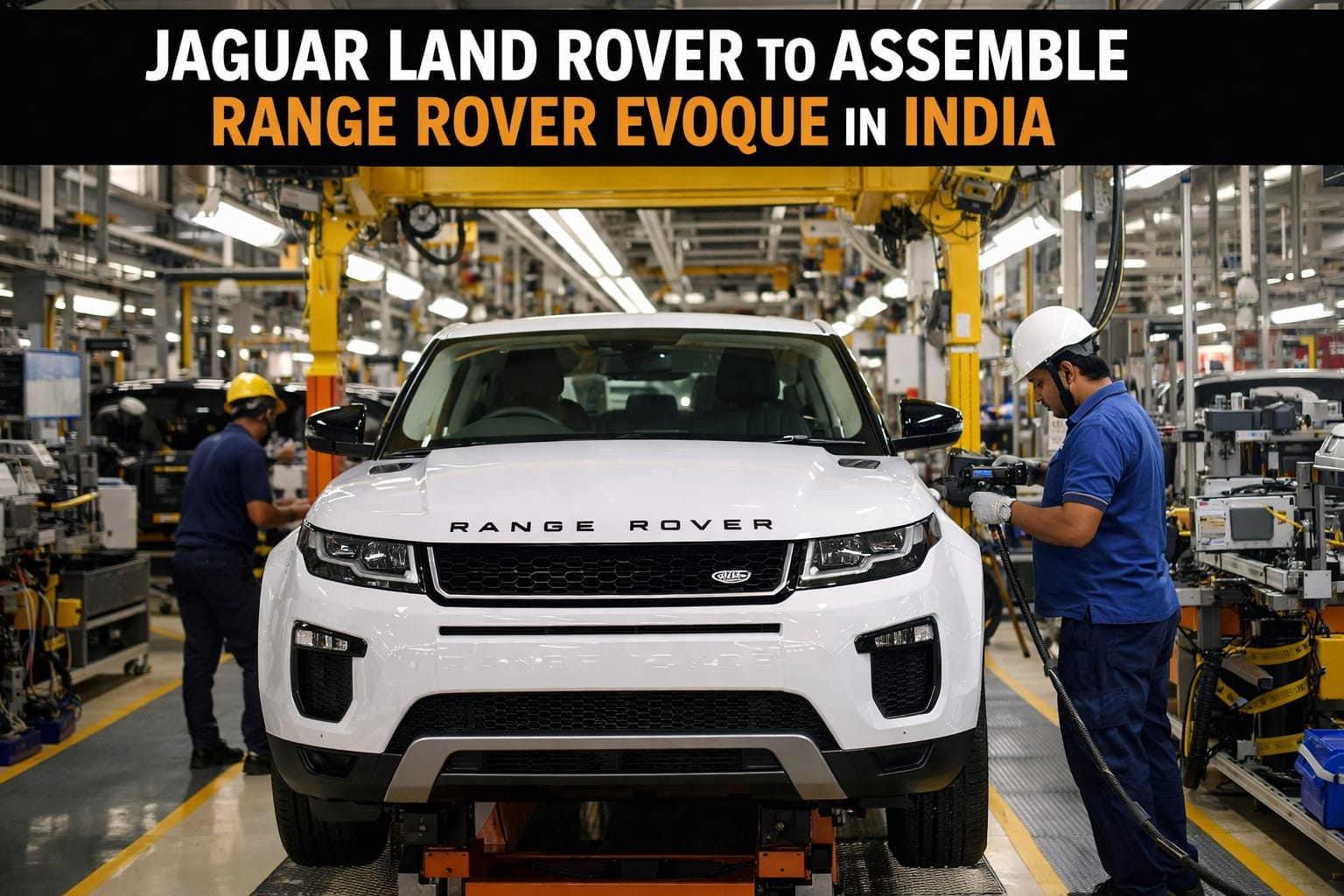
Jaguar Land Rover to Assemble Range Rover Evoque in India: A New Era of Local Production
Jaguar Land Rover to assemble Range Rover Evoque in India is fast becoming one of the most talked-about developments in the Indian automotive industry this year. This major strategic move by Jaguar Land Rover (JLR) and its parent Tata Motors will see the luxury British SUV assembled locally at a new manufacturing facility in Ranipet, Tamil Nadu, marking a significant boost to India’s “Make in India” initiative and strengthening the premium SUV market.
Expansion of Local Production
Jaguar Land Rover (JLR) has confirmed that production will begin at its brand-new Ranipet plant in Tamil Nadu in early 2026. This modern facility is part of a larger ₹9,000 crore investment by Tata Motors to expand its manufacturing footprint in southern India.
The plant’s initial focus will be on assembling the Range Rover Evoque and Range Rover Velar from Completely Knocked Down (CKD) kits imported from abroad. CKD assembly means the vehicle parts are shipped in components and then assembled locally — a strategy that reduces import taxes, brings prices down for consumers, and strengthens local industry participation.
What This Means for Indian Car Buyers
For Indian luxury SUV buyers, this is a welcome development. Until now, most Jaguars and Land Rovers sold in India were imported as fully built units or assembled at Tata’s Pune facility. Local assembly is expected to:
-
Lower prices due to reduced import duties.
-
Shorten delivery times for customers.
-
Make luxury ownership more attainable for aspirational buyers.
-
Boost demand by offering competitive pricing against rivals.
Customers have long appreciated the Range Rover Evoque. It already has a strong fan base in India thanks to its sleek design, premium features, and performance. The Evoque combines elegant British styling with modern technology and solid off-road capability — making it one of JLR’s best-selling models globally.
Ranipet Plant: A Strategic Manufacturing Hub
The Ranipet facility — covering nearly 470 acres near Chennai — is positioned as a major strategic hub for both Tata Motors and JLR. It not only supports current demand but also lays the foundation for future expansion in production volumes and potentially new models.
The plant’s initial phase will occupy about 70 acres with capacity planned at around 30,000 units per year, ramping up production gradually. In future phases, the plant could scale up to a capacity of 250,000 units annually, potentially including electric vehicle (EV) manufacturing for Tata’s Avinya platform and future JLR EVs — although some EV plans are reportedly on hold due to supply challenges.
A Boost for “Make in India” and Jobs
This expansion will have significant economic benefits:
-
Job creation — Thousands of direct and indirect jobs are expected once the plant is fully operational.
-
Supply chain growth — Local part suppliers and related industries will see increased demand.
-
Skill development — Advanced automotive technologies and assembly techniques will elevate workforce skills.
Government support for manufacturing growth has been a key factor in attracting investment in facilities like these, demonstrating India’s capabilities as a global auto production destination.
Why India Matters to JLR
India has emerged as a critical growth market for luxury automotive brands, including Jaguar Land Rover. Local assembly makes premium SUVs like the Range Rover Evoque more accessible to affluent buyers who previously faced steep import duties on fully built units.
JLR’s presence in India goes back many years, and assembling vehicles locally aligns with its long-term strategy to deepen market penetration while controlling costs, improving pricing, and managing supply chain efficiency.
The Range Rover Evoque: A Luxury SUV Favorite
The Range Rover Evoque itself has been one of JLR’s most popular models worldwide. Its compact luxury SUV stature appeals to urban buyers who desire premium style without sacrificing practicality.
In India, models like the Range Rover Evoque Autobiography have been showcased with advanced features such as mild-hybrid powertrains, premium interiors, panoramic sunroof, and sophisticated safety technologies — making it a compelling choice in the luxury segment.
Local assembly could enhance value even further by making such premium features available at slightly more competitive price points.
What’s Next for JLR in India?
While the initial focus is on the Evoque and Velar, industry observers anticipate future expansions. The Ranipet plant could eventually:
-
Produce other JLR models locally
-
Support hybrid and electric vehicles as tech evolves
-
Serve as an export hub for certain models in the future
That said, some reports indicate challenges in local EV production due to supply costs and quality issues, and JLR has paused some EV plans in the short term.
Jaguar Land Rover to assemble Range Rover Evoque in India is more than an auto manufacturing expansion — it’s a strategic move that reflects India’s importance in the global auto market. By localizing production at the Ranipet plant, JLR is not only reducing costs and improving availability but also contributing to India’s broader manufacturing and employment goals.
For luxury SUV enthusiasts, this means more accessible pricing, faster deliveries, and an exciting future of premium vehicles made right here in India.