

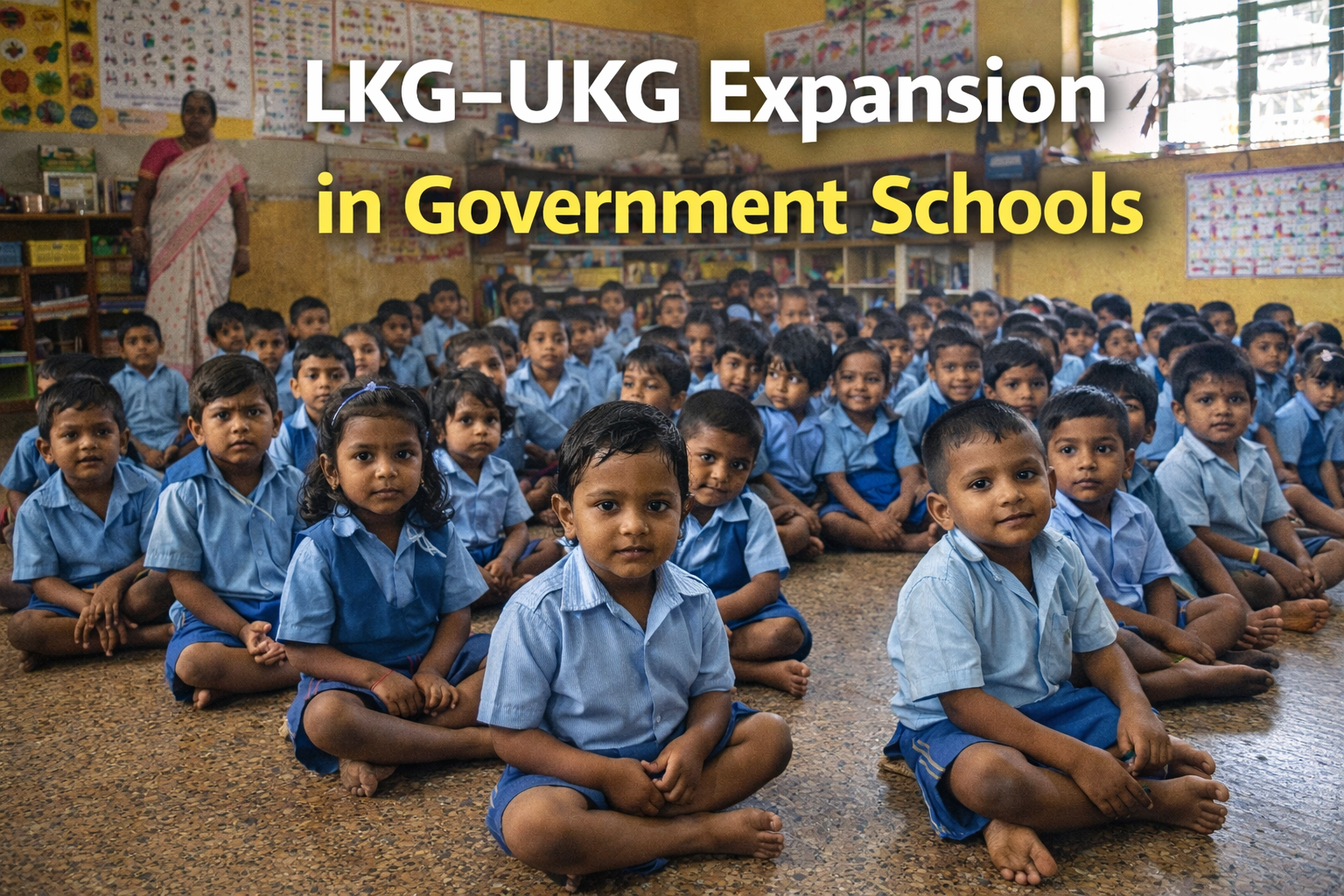
LKG–UKG Expansion in Government Schools: A Major Push for Early Education Reform
LKG–UKG expansion in government schools has emerged as a key education reform proposal aimed at strengthening foundational learning and ensuring equal access to quality early education. The move is expected to benefit thousands of children, particularly from economically weaker sections, by bringing pre-primary education into the public schooling system.
Education experts believe that introducing Lower Kindergarten (LKG) and Upper Kindergarten (UKG) classes in government schools can transform learning outcomes, reduce dropout rates, and bridge the gap between private and public education.
Why LKG–UKG Education Matters
Early childhood education plays a crucial role in shaping a child’s:
-
Cognitive development
-
Language skills
-
Social behaviour
-
Emotional stability
Research shows that children who receive structured pre-primary education perform better academically in later years. Until now, LKG and UKG education in India has largely been dominated by private schools, making it inaccessible for many low-income families.
The LKG–UKG expansion in government schools aims to correct this imbalance.
What the Expansion Proposal Includes
Under the proposed plan, the state government intends to:
-
Introduce LKG and UKG classes in thousands of government schools
-
Align teaching methods with the National Education Policy (NEP)
-
Recruit or train dedicated early-education teachers
-
Provide age-appropriate learning materials and play-based curriculum
-
Ensure infrastructure suitable for young children
This initiative is expected to be rolled out in phases to ensure quality implementation.
Alignment With National Education Policy (NEP)
The National Education Policy places strong emphasis on Foundational Literacy and Numeracy (FLN). According to NEP:
-
Learning gaps must be addressed at the pre-primary level
-
Education from ages 3 to 8 should follow a holistic, play-based approach
The LKG–UKG expansion proposal fits directly into this framework by integrating early childhood education with formal schooling.
Karnataka’s Focus on Early Learning
The proposal has gained attention in Karnataka, where education reforms have been a recurring focus in recent budgets and policy discussions. The state aims to strengthen government schools and reduce the dependency on private institutions for basic education.
By bringing LKG–UKG classes under government management, authorities hope to:
-
Improve enrollment in government schools
-
Build trust among parents
-
Ensure continuity in learning from kindergarten to higher grades
Expected Benefits for Students
1. Equal Access to Education
Children from rural and low-income families will gain access to structured early education without high fees.
2. Better Learning Outcomes
Early exposure to language, numbers, and motor skills improves long-term academic performance.
3. Reduced Dropout Rates
Students who start early are more likely to continue schooling through higher classes.
4. Smooth Transition to Primary Classes
Students entering Class 1 will already have basic reading, writing, and numeracy skills.
Benefits for Parents and Communities
Parents often spend a significant portion of their income on private pre-schools. The LKG–UKG expansion in government schools can:
-
Reduce financial burden
-
Encourage families to choose nearby government schools
-
Increase community participation in public education
In rural areas, this could also reduce travel distances for young children.
Infrastructure and Teacher Readiness
One of the major challenges is ensuring that government schools are prepared to handle pre-primary students.
Infrastructure Needs
-
Child-friendly classrooms
-
Safe toilets and drinking water
-
Play areas and activity spaces
-
Colourful and engaging learning environments
Teacher Training
Teaching young children requires specialized skills. The proposal includes:
-
Training existing teachers in early childhood education
-
Hiring specialized kindergarten educators
-
Continuous professional development programs
Challenges and Concerns
While the proposal has been widely welcomed, experts point out several challenges:
Quality vs Quantity
Rapid expansion must not compromise teaching quality.
Teacher Shortages
There is already a shortage of trained teachers in many regions.
Budget Allocation
Sustained funding is required for infrastructure, salaries, and materials.
Monitoring and Evaluation
Clear benchmarks must be set to track learning outcomes and implementation progress.
Comparison With Other States
Several Indian states have already started integrating pre-primary education into government schools. Early results show:
-
Improved enrollment numbers
-
Better attendance rates
-
Increased parental trust in public education
Karnataka’s proposal builds on these experiences while tailoring the model to local needs.
Long-Term Impact on Education System
If implemented effectively, the LKG–UKG expansion in government schools could:
-
Strengthen the foundation of the public education system
-
Reduce learning gaps between socio-economic groups
-
Improve overall literacy and numeracy levels
-
Create a more equitable education ecosystem
Experts say this reform could have a ripple effect across generations.
Role of Local Governments and School Committees
Successful implementation will depend on:
-
Active involvement of school development committees
-
Support from local bodies
-
Community monitoring and feedback
Public participation can help ensure accountability and transparency.
What Happens Next?
The proposal is expected to be discussed further during:
-
Budget announcements
-
Education department reviews
-
Pilot project evaluations
Once approved, phased implementation may begin in selected schools before statewide rollout.
Why This Proposal Is a Big Deal
The LKG–UKG expansion in government schools is not just an administrative reform—it is a social investment. By focusing on early education, the government is addressing learning gaps at their root rather than trying to fix them later.
For millions of children, this could mean a stronger start, better confidence, and a brighter future.
The proposal to expand LKG and UKG classes in government schools marks a significant shift in India’s approach to early education. By prioritising foundational learning, inclusivity, and accessibility, the initiative has the potential to redefine public schooling standards.
If executed with care, adequate funding, and trained educators, the LKG–UKG expansion in government schools could become one of the most impactful education reforms in recent years.