

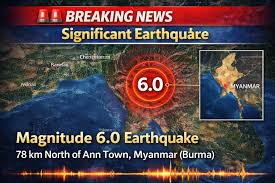
A magnitude-6 earthquake in Myanmar on Tuesday night sent powerful tremors across a wide region, with residents in eastern India — including the bustling city of Kolkata — feeling the ground shake as the seismic waves traveled hundreds of kilometers away from the quake’s epicenter.
According to seismic monitoring agencies, the earthquake struck Myanmar with a strength of approximately 6.0 on the Richter scale, occurring at a relatively shallow depth that amplified its effects over a broader area than might be expected for an earthquake of this magnitude.
The tremors were strong enough to be felt by residents in high-rise buildings, offices, and homes in eastern India, causing momentary panic and prompting people to step outside as a precaution. Officials have reported no major damages or casualties so far, but the event raised questions about seismic risk and preparedness in the region.
What Happened? A Closer Look at the Earthquake
The earthquake struck on the evening of February 3, 2026, and was detected by various seismological agencies, including the German Research Centre for Geosciences (GFZ) and the Indian Meteorological Department (IMD). While some reports list the magnitude as 6.0 and others as 6.1, all agree it was a moderately strong quake that produced noticeable shaking far from the epicenter.
In seismic terms, a 6.0-magnitude temblor is considered strong enough to be felt widely but typically only causes serious damage close to the epicenter — especially if it occurs underground at a shallow depth. This one occurred at around 10 km underground, meaning more energy was released closer to the surface.
Because the quake was shallow, it transmitted seismic energy effectively across regions with similar geological structures, such as the Indo-Burmese seismic zone. This is a tectonically active region where the Indian Plate meets the Burma microplate, creating stresses that can trigger earthquakes.
Why Were Tremors Felt So Far Away?
Earthquakes generate waves that travel through Earth’s crust. The distance these waves can travel — and the strength with which they are felt — depends on several factors:
-
Shallow Focus
Shallow earthquakes tend to send stronger signals to the surface than deeper ones, even when they are of similar magnitude. At 10 km depth, this quake had an unusually shallow focus, allowing it to be felt far beyond Myanmar’s borders.
-
Tectonic Setting
Myanmar lies on the boundary of two major tectonic units: the Indian Plate and the smaller Burma Plate. Movements along faults like the Sagaing Fault make this region prone to earthquakes. Historical quakes, including some stronger ones in the past, underscore this ongoing hazard.
-
Transmission Through Continental Crust
The way seismic waves propagate in continental crust — which is more rigid and continuous than oceanic crust — can carry tremors over longer distances, enabling people in eastern India to feel quakes that originate in Myanmar.
How Did Eastern India React?
In Kolkata and surrounding districts, residents felt a noticeable shake around 9:05 pm local time. Many reported that walls vibrated, ceiling fans swayed, and furniture rattled for several seconds, prompting people to evacuate buildings momentarily.
Office workers and residents said that although the shaking was brief, it was strong enough to unsettle many people. Social media soon filled with videos and messages from individuals describing their experience.
Despite the widespread sensation of the tremors, local authorities did not immediately report any damage to infrastructure or casualties. Emergency services in cities like Kolkata remained on standby but returned to normal operations soon after verifying no immediate risks emerged.
Expert Views: Seismologists Weigh In
Seismologists emphasize that the magnitude-6 earthquake in Myanmar belongs to a category of quakes that produce noticeable shaking without necessarily causing catastrophic destruction. However, they also stress that:
-
Regions like eastern India, especially those sitting on softer soil or near old riverbeds, can experience amplified shaking.
-
Even moderate earthquakes can trigger secondary effects like panic, minor structural issues in weaker buildings, or disruptions in infrastructure like utilities.
-
Continued monitoring is essential, as aftershocks — smaller tremors following a main quake — may still occur. These can sometimes be strong enough to be felt again.
A Broader Seismic Context
Earthquakes in Myanmar are not uncommon. Over the years, the region has experienced a variety of quakes — some small and some large — due to its complex plate boundary environment. Historical seismic activity indicates that the region should remain vigilant and improve infrastructure resilience against future events.
For instance, earlier major quakes — some exceeding magnitude 7 — have caused destruction in Myanmar and been felt in neighbouring countries, ranging from Thailand to India, as recently as 2025.
What This Means for Eastern India
Although this recent event did not result in significant damage or casualties, it serves as a reminder of seismic risk for regions in eastern India such as:
-
West Bengal
-
Assam
-
Bihar
-
Odisha
People in these areas should stay aware of earthquake safety guidelines and be prepared for future tremors, given that seismic activity in neighbouring tectonic zones can affect them too.
Safety Tips During Earthquakes
Here are essential safety steps to follow during and after an earthquake:
-
Drop, Cover, and Hold On:
Get under a sturdy table or desk and protect your head and neck. -
Stay Indoors Until Shaking Stops:
If you’re inside, wait until the shaking stops before moving to open spaces. -
Stay Away From Windows and Heavy Objects:
Glass and unsecured furniture pose serious risks during tremors. -
Have an Emergency Kit Ready:
Include essentials like water, first aid, important documents, and flashlights.
The magnitude-6 earthquake in Myanmar that struck on February 3, 2026, delivered a powerful reminder of the interconnected nature of seismic activity across borders. Although the quake did not cause severe damage, it was felt widely in eastern India, generating brief but noticeable tremors that alarmed residents in cities like Kolkata.
Seismologists agree that while such earthquakes are moderate on the scale, the potential for larger events remains — making preparedness and awareness key priorities for communities across the region.