

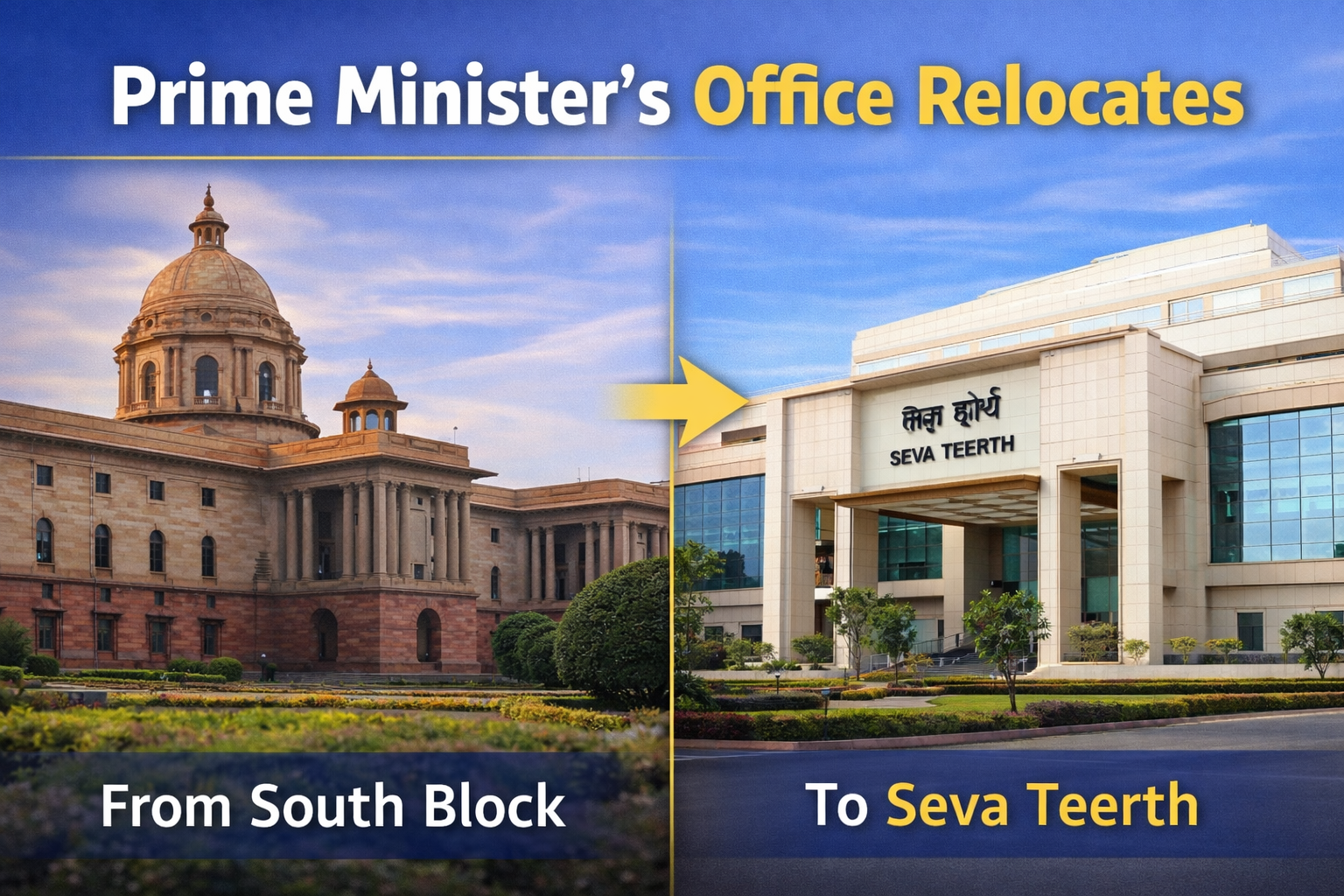
Prime Minister’s Office Relocates to Seva Teerth: A Historic Shift from South Block
Prime Minister’s Office relocates from the iconic South Block in New Delhi to a state-of-the-art facility known as Seva Teerth, marking a historic administrative change in modern Indian governance. This relocation — a part of India’s ambitious Central Vista redevelopment project — symbolizes not just a shift of physical office space but also a strategic effort to modernize the country’s administrative infrastructure for enhanced efficiency, service, and governance.
In this detailed article, we will explore the background of the move, why it matters, what the new Seva Teerth complex offers, and the broader vision shaping this transition.
What Does Prime Minister’s Office Relocates Mean?
The phrase Prime Minister’s Office relocates refers to the physical move of the PMO headquarters — which has been housed in the South Block of Rashtrapati Bhavan since India’s independence in 1947 — to a newly built facility named Seva Teerth in New Delhi.
South Block, with its colonial-era architecture and deep historical associations, has been the nerve center of India’s political administration for more than seven decades. With the shift to Seva Teerth, the Indian government aims to bring its central administrative processes into a modern workspace that reflects a forward-looking governance mindset and operational efficiency.
Why the Relocation Happened
Several key factors shaped this decision:
Modern Administrative Needs
The historic South Block structure, while symbolic, was not designed for the demands of 21st-century governance and collaboration across multiple government agencies. The move helps accommodate expanded staff needs and modern technology infrastructure.
Part of the Central Vista Redevelopment Project
The relocation is a key element of the Central Vista redevelopment initiative, a large-scale project to redesign and modernize New Delhi’s government precincts — including Parliament House, Rajpath (now Kartavya Path), and common secretariat buildings — to improve space utilization and institutional coordination.
Administrative Consolidation
Seva Teerth is designed to house not only the Prime Minister’s Office but also related bodies like the Cabinet Secretariat and the National Security Council Secretariat in close proximity, facilitating coordination and quicker decision-making.
Symbolic Significance
The relocation from South Block, built during the British era, to an Indian-designed facility underscores a move from colonial architecture to an indigenous vision of governance, further reinforced by renaming and rebranding efforts across government spaces.
where Is Seva Teerth?
Seva Teerth is located in the heart of New Delhi near the historic Raisina Hills, replacing the old Executive Enclave.
The complex includes:
-
Seva Teerth-1: The new Prime Minister’s Office
-
Seva Teerth-2: The Cabinet Secretariat
-
Seva Teerth-3: Office of the National Security Council Secretariat and related offices
This setup is designed to streamline government functioning while providing a modern, flexible workspace environment.
History of the PMO at South Block
Since 1947, the PMO (Prime Minister’s Office) has operated from South Block alongside other ministries such as the Finance Ministry and Defence Ministry. South Block — part of the Rashtrapati Bhavan complex — became synonymous with India’s central administration post-Independence.
Over the decades, as governance needs expanded and digital workflows emerged, space and infrastructure limitations at this colonial-era building became evident. Modern requirements of connectivity, security, and collaborative working further highlighted the need for a state-of-the-art facility — leading to the decision to relocate the PMO.
What Seva Teerth Offers
The Seva Teerth complex is built with modern governance in mind:
-
Advanced Workspace
High-tech communication systems, ample space, and technology-friendly meeting rooms aid in real-time collaboration with government officials, policy planners, and international dignitaries.
-
Heritage Meets Modernity
While embracing modern design, the complex incorporates cultural motifs and reflects India’s architectural legacy alongside functional efficiency — contrasting with the strictly colonial aesthetics of South Block.
-
Integration with Key Government Bodies
Seva Teerth brings the offices of the PMO, Cabinet Secretariat, and National Security Council Secretariat closer, ensuring optimal coordination during national decision-making processes.
Significance of the Prime Minister’s Office Relocates
The relocation has several implications:
-
Administrative Efficiency
Bringing core decision-making bodies together in one complex promotes faster administrative responses and efficient policy implementation.
-
National Identity and Vision
The move from historical South Block to Seva Teerth reflects the government’s objective of embedding service-oriented governance into the administrative core. The word “Seva” literally means service, symbolizing a shift from power to public service.
-
Heritage Reimagined
North and South Blocks will be repurposed — such projects include the transformation of these historic buildings into public museums preserving India’s administrative legacy.
What’s Ahead for Central Delhi’s Government Infrastructure
The relocation of the PMO is part of the broader Central Vista Project which includes:
-
Kartavya Path: The redesigned ceremonial avenue replacing Rajpath.
-
Common Central Secretariat Buildings: A consolidated workplace for 51 ministries.
-
Kartavya Bhavan: New consolidated secretariat buildings replacing older blocks.
These initiatives reflect a vision to streamline governance and reimagine India’s administrative capital for the 21st century.
The Prime Minister’s Office relocates from South Block to the Seva Teerth complex marks one of the most symbolic and practical governance shifts in independent India’s history. More than changing offices, the move represents India’s journey toward modern, efficient, and service-oriented governance.
From embracing advanced infrastructure to consolidating central administration and redefining institutional identity, this relocation highlights the nation’s focus on future-ready government architecture — both in form and function.