

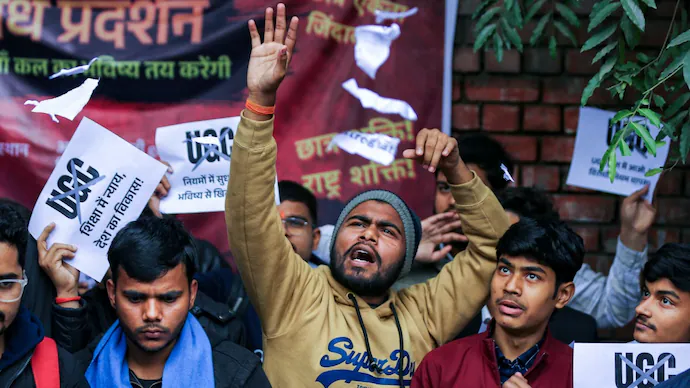
UGC Protests in India
The UGC Protests in India have rapidly evolved into one of the most significant education policy controversies of early 2026. What began as changes to the university governance framework has now triggered nationwide demonstrations, political debates, legal challenges, and a Supreme Court intervention — all centering around the University Grants Commission’s (UGC) Promotion of Equity in Higher Education Institutions Regulations, 2026.
This article explains what the new rules are, why they sparked massive protests across states, how different stakeholders are responding, and what the Supreme Court decision means for the future of India’s higher education system.
What Are the New UGC Equity Rules?
In mid-January 2026, the UGC — India’s main higher education regulator — introduced a new set of regulations titled the Promotion of Equity in Higher Education Institutions Regulations, 2026. These rules are designed to prevent discrimination in colleges and universities and to create structured mechanisms to address grievances related to caste, religion, gender, disability, and other forms of bias.
Key Provisions in the 2026 Regulations
-
All universities and colleges must establish Equal Opportunity Centres (EOCs).
-
Each institution must form an Equity Committee tasked with handling complaints of discrimination.
-
There are 24×7 helplines and online reporting systems to register grievances.
-
The committee is expected to recommend corrective actions and monitor campus inclusion efforts.
Government officials and the UGC say these measures are intended to strengthen protections for historically disadvantaged groups — particularly students and staff from Scheduled Castes (SC), Scheduled Tribes (ST), and Other Backward Classes (OBCs).
Why the UGC Protests Erupted Nationwide
Although the stated goal of the new UGC equity rules is inclusion, protests erupted across India almost immediately after the notification. Demonstrations took place on campuses and in major cities, with different groups raising distinct but overlapping concerns.
1. Claims of Reverse Discrimination
Many protesters, particularly from the general (unreserved) category, argue the new rules do not protect all students equally. They claim:
-
The regulations define discrimination narrowly — focusing on caste-related bias against SC/ST/OBC communities — which critics say excludes general category students from filing complaints of caste-based harassment.
-
There are no safeguards for false or malicious complaints in the final version of the regulations, which protesters fear could be misused to target innocent students unjustly.
In several cities including Lucknow, Varanasi, Deoria and Ghaziabad, protesters staged dramatic demonstrations — from wearing black bands to symbolic tonsuring — to show their displeasure and warn of prolonged agitation if the rules are not repealed.
How the Protests Spread Across Campuses
What began as small gatherings escalated quickly into organized protests on multiple university campuses:
-
Delhi University: Hundreds of students gathered near the Arts Faculty, calling the regulations “biased and divisive” and demanding a complete rollback. They submitted memoranda to university authorities and warned of indefinite strikes should their concerns remain unaddressed.
-
Pilibhit and Uttar Pradesh districts: Demonstrators, including lawyers and youth groups, marched to local collectorates, delivered memoranda to officials, and used symbolic gestures like shaving heads to emphasize their protest.
These campus protests reflect a broader student-led response, with youth and civil society groups amplifying the message nationwide.
Political and Social Reactions
The controversy over the UGC regulations has sparked responses far beyond campuses:
Government Response
Union Education Minister Dharmendra Pradhan publicly assured that “no one will be harassed or allowed to misuse the guidelines” and emphasized that the rules would be implemented fairly and constitutionally.
Political Parties
Political positions have been divided:
-
Some parties support the equity measures, arguing they are essential for rectifying historical imbalances in education.
-
Others criticize the regulations as poorly drafted and potentially harmful. A public interest litigation (PIL) was filed in the Supreme Court challenging the constitutional validity of the rules.
Social and Cultural Voices
Religious and social leaders also weighed in, warning the rules could deepen societal divides if not carefully implemented. Some saw this as a broader cultural issue extending beyond education policy.
Supreme Court Intervention: A Major Turning Point
In a significant development on January 29, 2026, the Supreme Court of India issued a temporary stay on the implementation of the 2026 UGC equity rules. The court noted that several provisions — especially those related to the definition of caste-based discrimination — were vague and possibly prone to misuse, and thus needed judicial scrutiny before going into force.
As a result:
-
The older UGC 2012 regulations will remain in effect for now.
-
The Supreme Court is expected to hear the broader challenge to the rules’ constitutionality.
This pause has provided temporary relief to protesters, who welcomed the decision but are continuing their calls for a permanent repeal or revision.
What Happens Next?
With the regulations on hold and a legal battle underway, several key questions remain:
-
Will the UGC revise its equity rules to address concerns about fairness and clarity?
-
How will universities balance anti-discrimination efforts with protections for all students?
-
What will the Supreme Court ultimately decide regarding the constitutional validity of the regulations?
The nationwide protests and judicial intervention demonstrate how deeply education policy intersects with social justice, identity, and constitutional rights in India — making this controversy a landmark in contemporary policy discourse.
The UGC Protests in India reflect a momentous clash between reformist intentions and public apprehension. Although the new equity rules were designed to tackle discrimination and foster inclusive campuses, widespread dissent has pushed policymakers into reconsideration and judicial scrutiny. As the debate continues, one thing is clear: India’s higher education landscape is undergoing one of its most intense policy debates in decades — one that will shape how equity and fairness are understood and enacted in schools and universities across the country.